COD Order Management: The Complete Guide for Pakistani Sellers
Everything that actually matters in COD order management for Pakistan — screening, confirmation, courier booking, and RTO — in one guide.

Umair
Founder @ ClicknShip.app | Helping eCommerce businesses reduce RTO, automate fulfillment, and improve operational efficiency
"COD order management" isn't one feature — it's everything that happens between a customer clicking "place order" and a courier either delivering it or sending it back. This guide walks through each stage for Pakistan's cash-on-delivery e-commerce, with a link to a full breakdown of each one.
The order management funnel, COD-specific
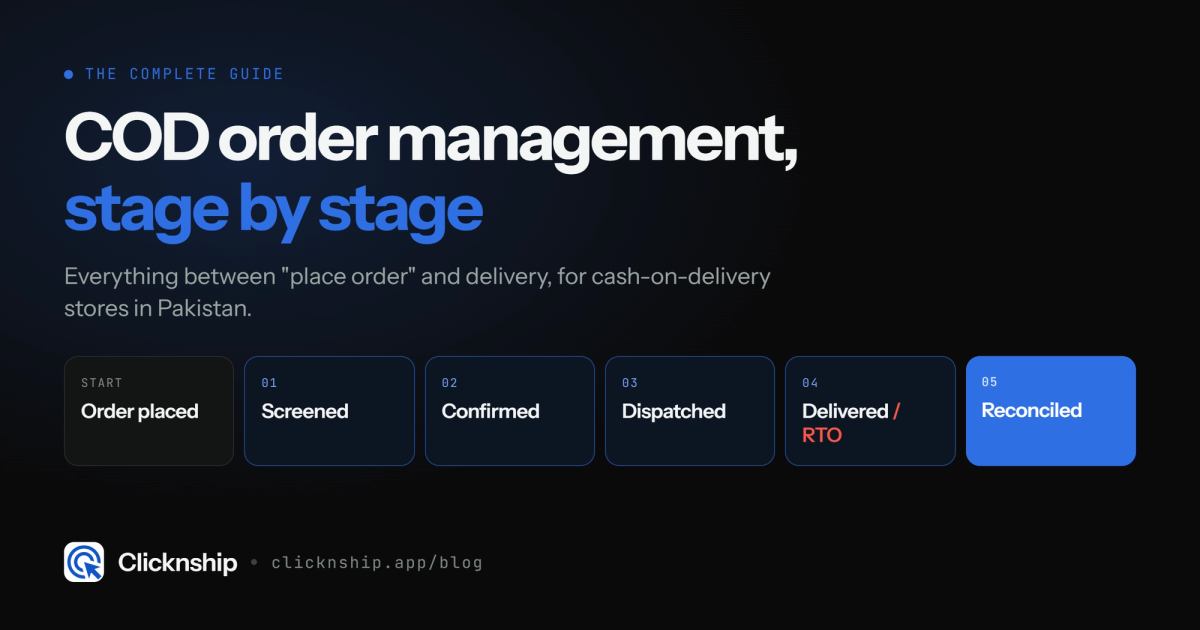
Order placed → screened for fraud risk → confirmed, either automatically or by an agent → dispatched to a courier → delivered or returned as RTO → reconciled against COD remittance. Every stage after "order placed" is where margin is won or lost, and most generic order-management content skips straight to "courier integration" without covering what happens before it.
1. Screening orders before they cost you a courier fee
Fake and duplicate orders cost money before a single item ships. See the full COD buyer's guide for what to actually screen for and why most platforms only report fraud after it's already cost you a dispatch fee.
2. Confirming orders in a way customers actually respond to
Phone confirmation doesn't scale and still misses customers. See how WhatsApp auto-confirmation works and why it measurably lowers RTO compared to a call that rings out.
3. Booking and managing couriers from one dashboard
"Courier integration" means different things to different platforms. See what courier management should actually look like across TCS, Leopards, M&P, PostEx, Daewoo, and Trax.
4. Catching returns before they become RTO
Most RTO is decided before the parcel ever leaves the warehouse, not at the courier. See the three checkpoints that catch it before dispatch.
5. Pricing: paying for what you actually use
COD order volume in Pakistan is seasonal, not steady — which changes how pricing should work. See why usage-based pricing fits seasonal volume better than a flat SaaS fee, and what to actually compare before picking a platform.
Treat each of these five stages as a separate decision, not one bundled "does it have courier integration" checkbox — that's the practical difference between a platform that happens to work for COD and one actually built for it.
FAQ
What's the difference between order management and inventory management?
Inventory management tracks what stock you have and where. Order management handles what happens to a specific customer order — screening, confirmation, dispatch, and returns. They need to talk to each other (a confirmed order should reserve stock) but they're solving different problems.
Do I need separate software for each stage, or should it be one platform?
One platform's real advantage is that risk signals flow directly from screening into confirmation and dispatch decisions, rather than living in separate tools that don't talk to each other.
How long does it take to set up COD order management software?
Typically days, not months, if it integrates directly with your existing store and couriers rather than requiring a migration.
Ready to put screening, confirmation, courier booking, and RTO reporting under one roof? Start with ClickNShip.