Courier Management in Pakistan: Booking TCS, Leopards, M&P, PostEx, Daewoo & Trax From One Dashboard
Comparing courier management systems in Pakistan? Here's what "integration" should actually mean — one dashboard for booking, tracking, and RTO across couriers.

Umair
Founder @ ClicknShip.app | Helping eCommerce businesses reduce RTO, automate fulfillment, and improve operational efficiency
"Courier management system" and "courier integration" get used loosely. Some platforms mean "we can push a booking to one courier's API." Few mean "book, track, and reconcile across every courier you actually use, from one screen, without reopening five browser tabs for anything beyond the basic label."
What "courier integration" usually means vs. what it should mean
Booking-only integration means a platform can create a shipment on one courier's system. Full lifecycle management means booking, automatic load-sheet generation, tracking status normalized across couriers, RTO and return handling, and COD remittance reconciliation — across several couriers at once, not just one.
The real operational cost of juggling separate courier portals
Re-entering the same order data into a different courier portal costs time per order, every day. Inconsistent status terminology across couriers makes reporting painful — "out for delivery" means something slightly different depending on the carrier. And without a single view, there's no easy way to see which courier is actually performing well in which city; that judgment usually ends up based on impression rather than data.
What one dashboard should actually let you do
Bulk booking across orders regardless of which courier each is assigned to. Auto-generated load sheets per courier instead of built by hand. A single tracking view with normalized status, regardless of carrier-specific labels. And RTO plus delivery performance broken down by courier and city in the same report, not five separate exports stitched together manually.
Choosing couriers by city, not by default
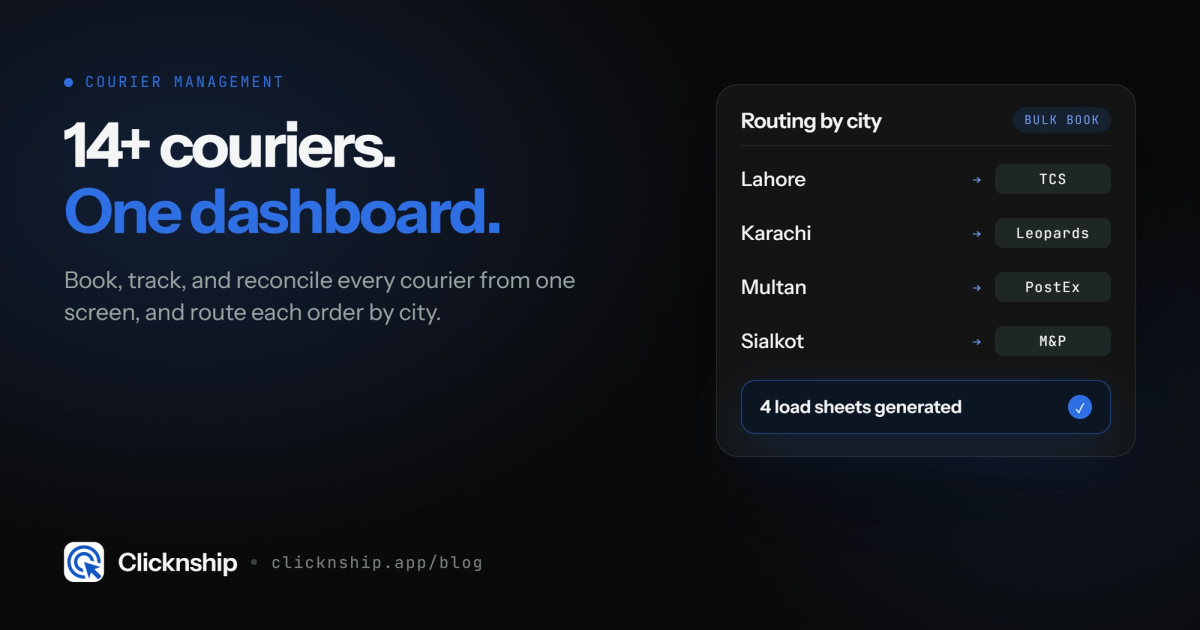
No single courier performs best everywhere in Pakistan — a courier reliable in Lahore may have a weak network in a smaller city. The point of multi-courier integration isn't redundancy for its own sake; it's being able to route each order to whichever courier performs best for that specific city, without extra manual work to make the switch.
A short checklist
- Can you book across TCS, Leopards, M&P, PostEx, Daewoo, and Trax from one screen, not five?
- Are load sheets generated automatically per courier, or built by hand each time?
- Is tracking status normalized across couriers, or do you have to learn each courier's own status labels?
- Can you compare delivery performance and RTO by courier and by city in the same report?
- Does switching a courier for one city require reconfiguring your whole setup, or just a routing rule?
ClickNShip's courier integration is built around this directly — one dashboard, native to the couriers Pakistani COD sellers actually use.
FAQ
Do I need to integrate every courier, or just one?
Most sellers get the real benefit from two or three couriers chosen by city coverage, not from integrating every courier available. Start with the couriers that actually serve your top delivery cities well.
Does switching between couriers require re-training staff?
Not if the dashboard normalizes statuses and the booking flow across couriers — staff book and track the same way regardless of which courier is assigned to a given order.
How is courier performance measured fairly across different cities?
Compare delivery success rate and RTO rate for the same city across couriers, not one courier's national average against another's — national averages hide the city-level differences that actually drive the routing decision.
Want TCS, Leopards, M&P, PostEx, Daewoo, Trax, DEX, AHL, Dastaq, BurqRaftar, Digi, Tranzo, and more bookable from one dashboard? Start with ClickNShip.